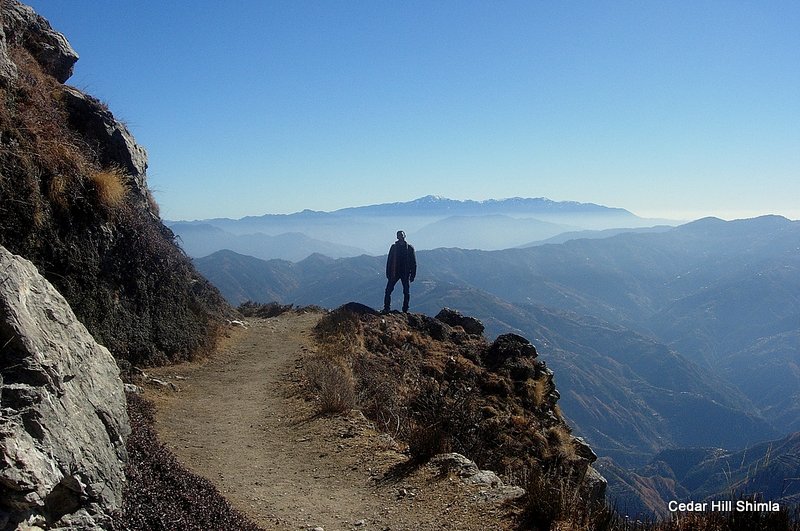
Shimla Water Catchment Sanctuary
About the Sanctuary:
Simla Water Catchment Sanctuary is situated adjacent to National Highway 22 and immediately north of Kufri, which lies some 12km by road east of Simla. The WCA Sanctuary, situated 8 Kms East of Shimla at an altitude of 1915 m to 2750 m, is a 20 minute drive from the city, via the Sanjauli-Dhalli Tunnel.
The area under this sanctuary is 951ha using digitised maps with an altitude ranges from 1,900m to 2,620m. The sanctuary is connected by a forest corridor to Chail Sanctuary in the south. This sanctuary comprises a moderately steep catchment which is the main water supply for Simla. Nine perennial streams flow from this area, the main ones being Churat Nala and God Ki Nala. Mean annual rainfall is 1600mm and temperatures range from 5.4 C to 32 C. Meteorological data are also available from nearby at Simla at 2,200m. Here, annual precipitation is in excess of 1500mm, over half of which falls during the summer monsoon. Mean monthly maximum and minimum temperatures range from 8.6 C in January to 24.1 C in July and from 1.9 C to 15.7 C, respectively.
 |
| Shimla Water Catchment Sanctuary (View from the highway) |
|
|
|
|
|
|
|
|
|
|
|
|
|
|
|
|
|
|
|
|
|
|
|
|
|
|
|
|
|
|
|
|
|
|
|
|
|
|
|
|
|
Charabara Village is surrounded on three sides by the magnificent Shimla Water Catchment Sanctuary, a 125 year old sanctuary that was established by the British as a reserved forest. The sanctuary was the initial source of water for Shimla, the water pumped to Shimla town through a series of steam pumps, reputed to be the first of their kind in the country. Today this pristine and undisturbed forest stretches across an area of 12 square kilometres and is considered by many as one of the wealthiest storehouses of Himalayan flora. It is home to two species of pheasants – the Koklass pheasant and the Kaleej pheasant. This sanctuary is also a source of water supply to Shimla city, as the rain-fed stream water is collected in a large tank constructed over a century ago within the sanctuary.
The sanctuary spreads over an area of 1015.02 ha, and was leased in perpetuity by the owner - Rana of Koti Estate - to the Shimla Municipal Committee in 1878. The forest was declared a Protected Forest in 1952; and was finally notified as a Wildlife Sanctuary in 1999. Till year 2006, it was under the administrative control of the Municipal Corporation of Shimla, and was handed over to the Wildlife Division of Shimla in 2009.
The sanctuary has a road going upto Seog that is accessible by car and bicycle; and various walking trails. The hiking trails can be covered on foot in 3-5 hours. The trail leading upto Chharabra offers the best wildlife sightings. At present, a wood cabin serves as a reception area for visitors where they can get permits for cars and bicycles (a fee of Rs. 25 per person and Rs. 200 per vehicle is charged). Visitors can also hire bicycles at the cabin for a small fee. Visitors can drive upto the water tank at Seog, and can obtain a permit for stopping at the Forest Rest House during the day. A new zonal office is being constructed at the entrance that is expected to be completed by next year. [ For information, contact : Wildlife Warden-cum-Deputy Conservator of Forests, Wildlife Division, Shimla. Telephone: 0177-2623993 ). Visitors are advised to take a guide/guard along while hiking, or be suitably prepared in case they encounter a leopard or a bear.
The Himalayan Black Bear and the Brown Bear, Barking Deer, Goral, Jackal, Indian Red Fox, Striped Hyena and the Yellow-Throated Martin are some of the species of wildlife that thrive in the undisturbed forests of the sanctuary. A wide variety of bird and pheasant species can also be spotted in the lower altitude belts of the sanctuary, some of the more prominent ones being the Cheer, Koklas and Khaleej pheasants, the Himalayan Pied Woodpecker, the Great Himalayan Barbet and some sparklingly colorful minivets.

A bifurcation penetrates deep into the sanctuary along a prominent ridgeline. Descend down to the Seyog Forest Rest House, a hundred year old lathe and plaster (Dhajji) structure located in the midst of this silent forest. The narrow trail undulates for an hour or more through one of the best-preserved forests in Asia. Cedars, Firs, Pines and Oaks jostle each other for space and the canopy-density at places prevents even the sunlight from peeping through to the forest floor. Droppings and pugmarks of the fauna are regular sightings along this trail and if ones luck holds out, a perky Barking Deer too might flash past in gay abandon. As one would guess, this is an excellent site for some bird-watching too.
AREA AND ZONING: 1025.3ha. (10.25sq.km). No zoning.
LOCATION: District Shimla; Latitudinal range 31º 05´12" to 31º07´11"N; longitudinal range 77º 12´54" to 77º 16´04"E.
TOPOGRAPHY AND CLIMATE: Altitude 1900mtr to 2620mtr; Maximum temperature 23º C; Minimum temperature -5.4°C; an annual rainfall 1600mm.
FLORA:
The vegetation consists predominately of temperate coniferous forest, dominated by Himalayan Cedar (Deodar), and mixed at lower elevation with White Oak and patches of Chill Pine, and at higher elevation with blue pine, average about 50% cover ground vegetation is predominately grasses, but includes a variety of ferns and vascular herbs.
Forest type include Himalayan Subtropical Pine Forest; Lower Western Himalayan Temperate forest, Ban Oak Forest, moist Cedar Forest, which cover the major portion of the sanctuary.
FAUNA:
Mammals
 |
| Pine Martin |
Leopard, Rhesus Macaque, Barking Deer, Pine Martin, Musk Deer, Himalayan Yellow Throated Porcupine, Goral, Indian Sambar, Kashmir flying Squirrel and common Langur.
Pheasants:
 |
| Red Jungle Fowl |
Red Jungle fowl (Gallus Gallus),
Chir Pheasant (Catreus Wallichii)
Khalij Pheasant (Lophura Leucomelanos)
 |
| Khalij Pheasant |
 |
| Chir Pheasant |
Barking Deer:
 |
| Barking Deer |
This shy and elusive member of the deer family is spread across all the dense jungles of India. It has been named after its call, which bears a striking resemblance to the bark of dog. These animals grow to a height of 50 - 75 cms and weigh 20 -30 kgs. They have a life expectancy of between 20 - 30 years. They mostly live in solitude and are only very rarely seen in numbers exceeding two. Due to their low height and small stature, their main diet consists of grass and fallen fruits. They rarely venture out into open grasslands and are mostly seen feeding near the edge of dense forests. They can also be frequently seen at salt licks like the one shown in the picture below. They are mostly diurnal in habit but it is close to impossible to see them at night due to their dense habitat areas. Their alarm call, unless endlessly repeated, is not taken seriously as an indication of the presence of a predator. They are easily startled by any movement.
A definite identification mark to recognise a barking deer is from the two raised dark ridges on the forehead that extend into its antlers. Barking Deer are often seen at salt licks. A unique trait of the Barking deer is that, unlike other members of the deer family, they possess a pair of antlers as well as overgrown canines known as tushes. Both these are used as weapons in combat but the tushes are used more effectively and frequently. They are commonly found across the country and have fortunately not yet found their name on the endangered list.
 |
| Goral |