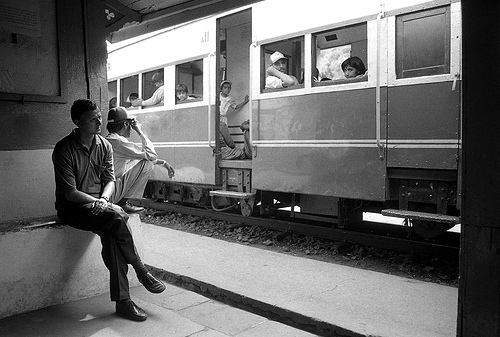
The Kalka–Shimla Railway is a 2 ft 6 in (762 mm) narrow gauge railway in
North-West India travelling along a mostly mountainous route from Kalka
to Shimla.
It is known for breathtaking views of the hills and surrounding villages.
Please Note: Travelling by the Kalka Shimla Train network takes more time (3-4 Hrs. approx.) to reach Shimla. The train chugs along at a gradual speed which is ideal for tourist, photographers and seeping in the sights of the lower himalayan hills.. By Road (Highway): The route from Kalka-Shimla takes 2 Hours (approx.)
Mountain Railways of India *
UNESCO World Heritage Site
* Name as inscribed on World Heritage List
** Region as classified by UNESCO
HISTORY:
Shimla (then spelt Simla) was settled by the British shortly after the first Anglo-Gurkha war, and is located at 7,116 feet (2,169 m) in the foothills of the
Himalayas. By the 1830s, Shimla had already developed as a major base for the British.[citation needed] It became the summer capital of British India in 1864, and was also the headquarters of the British army in India. Prior to construction of the railway communication with the outside world was via village cart.
The railway was constructed by the Delhi-Ambala-Kalka Railway Company commencing in 1898.[1] The estimated cost of Rs 86,78,500, however, the cost doubled during execution of the project.[citation needed] The 96.54 km (59.99 mi) line was opened for traffic November 9, 1903. Because of the high capital and
the maintenance cost, coupled with peculiar working conditions, the Kalka–Shimla Railway was allowed to charge fares that were higher than the prevailing tariffs on other lines. However, even this was not good enough to sustain the company and the Government had to purchase it on January 1, 1906 for Rs 1,71,07,748.
Ordinary local train halts at the Solan Station.
In mid-August 2007, the government of Himachal Pradesh declared the railway a heritage property in preparation for its review in September.
On this route a city named Solan is passed through, which is also known as mini Shimla. During summer season a festical celebrating a goddess (Shoolini Devi), after which the city is named, is held in June.
For about a week starting on September 11, 2007, an expert team from UNESCO was on a visit to the railway to review and inspect the railway for possible selection as a World Heritage Site. On July 7, 2008, the Kalka–Shimla Railway was included in the UNESCO World Heritage List as part of the World Heritage
Site Mountain Railways of India.[3] The Mountain Railways of India (including Darjeeling Himalayan Railway and Nilgiri Mountain Railway) and Chhatrapati Shivaji Terminus in Mumbai have already been declared as world heritage properties.
 Route:
The Kalka–Shimla Railway was built to connect Shimla, the summer capital of India during the British Raj, with the Indian rail system. Now, Shimla is the
capital city of Himachal Pradesh and Kalka is a town in the Panchkula district of Haryana. Spectacular scenery along the whole route, and the marvels of its
construction, keeps the traveler on this line spell bound. On leaving Kalka, 656 meters (2,152 ft) above sea level, the railway enters the foothills and immediately commences its climb.
Stations
The route offers a panoramic feast of the picturesque Himalayas from the Sivalik foot hills at Kalka to several important points such as Dharampur, Solan, Kandaghat, Taradevi, Barog, Salogra, Summerhill and Shimla at an altitude of 2,076 meters (6,811 ft).A typical passenger train on one of the line's large bridges
Tunnels
The Kalka–Shimla Railway runs through 103 tunnels (one is not in use; so only 102 in service). The longest tunnel Barog, and is associated with local tales and legends related to its realization.
Infrastructure
The line has 864 bridges, one of which is a 18.29 metre (60 ft) plate girder span and steel truss. The others are viaducts with multi-arched galleries like the ancient Roman aqueducts. Bridge No. 493, historically known as the "Arch Gallery", situated between Kandaghat and Kanoh stations, is an arch bridge in three stages, constructed with stone masonry. Bridge No. 226; between Sonwara and Dharampur is an arch gallery bridge having 5 tier galleries of multiple spans, constructed with stone masonry and bridging a deep valley surrounded by high peaks.
The railway has a ruling gradient of 1 in 33 or 3%. It has 919 curves, the sharpest being 48 degrees (a radius of 37.47 m or 122.93 feet). Climbing from 656 meters (2,152 ft), the line terminates at an elevation of 2,076 meters (6,811 ft) at Shimla. The line originally used 42 lb/yd (21 kg/m) rail but this was later relaid to 60 lb/yd (30 kg/m) rail.
Locomotives:
The first locomotives to arrive were two class "B" 0-4-0ST from the famous Darjeeling Himalayan Railway. These were built as 2 ft (610 mm) gauge engines, but were converted to 2 ft 6 in (762 mm) gauge in 1901. They were not large enough for the job, and were sold in 1908. They were followed by 10 engines with a 0-4-2T wheel arrangement of a slightly larger design, introduced in 1902. These locomotives weighed 21.5 tons (21.85 tonnes) each, and had 30" (762 mm) driving wheels, and 12"x16" (304.8 mm x 406.4 mm) cylinders. They were later classified into the "B" class by the North Western State Railways. All these locomotives were constructed by the British firm of Sharp, Stewart and Company.
Larger locomotives were introduced in the form of a 2-6-2T, of which 30 were built with slight variations between 1904 and 1910. Built by the Hunslet and the North British Locomotive Company, these locomotives were about 35 tons (35.56 tonnes), with 30" (762 mm) drivers and 14"x16" (355.6 mm x 406.4 mm) cylinders.
These locomotives, later classed K and K2 by the North Western State Railways, subsequently handled the bulk of the railways traffic during the steam era. A pair of Kitson-Meyer 2-6-2+2-6-2 articulated locomotives, classed TD, were supplied in 1928. They quickly fell into disfavour, as it often took all day for enough freight to be assembled to justify operating a goods train hauled by one of these locomotives. Shippers looking for a faster service started to turn to road transport. These 68 ton (69.09 tonnes) locomotives were soon transferred to the Kangra Valley Railway, and subsequently ended up converted to 1,000 mm (3 ft 3 3/8 in) gauge in Pakistan.
TRAINS:
Shivalik Deluxe Express (5:40)
Shivalik Queen: It is a luxury coach generally attached to Rail Cars. This is specially designed for couples. This coach has four (4) nos. of elegantly furnished coupe with two toilets for the luxury of travel, i.e. ideally designed for four couples. It also provides exclusive privacy to couples. It has Wall to wall carpet, big windows for scenic view of the hills.This coach named Shivalik Queen (RA-67) can be booked only as charter booking through IRCTC LTD-Chandigarh office. The journey costs Rs 4200/- for four couples including lunch. The train usually departs from Kalka at 08:30 h and reaches Shimla by 14:00 h.
Himalayan Queen (12:15)
Rail cars (5:20), which looked like buses on the rail, were used to transport upper class travellers. The fare for these cars was almost double that of the first class ticket. The travel time by these rail cars was less than three hours from Kalka to Simla whereas trains take between five to six hours to complete this journey.
The BBC:
In the UK, the BBC have made a series of three documentaries dealing with Indian Hill Railways http://www.bbc.co.uk/programmes/b00qzk9r of which the first
deals with the Darjeeling Himalayan Railway. The Kalka–Shimla Railway was the subject of the third programme shown on BBC4 television in February 2010, on
BBC2 in April 2010 and on BBC4 in January 2012. Director: Hugo Smith; producer: Gerry Troyna.[7] (This programme is available on DVD from the bookstall at Shimla Station).
Please Note: Travelling by the Kalka Shimla Train network takes more time to reach Shimla. The train chugs along at a gradual speed which is ideal for tourist, photographers and seepin in the sights of the lower himalayan hills..
Arriving to Shimla by TRAIN: Tickets can be booked through irctc.co.in for the following trains
Economical, deluxe and premium services for travelers on the Kalka-Shimla rail section are made available by the Indian railways. The time table is set as per further train connectivity and general tourist requirements.
Special trains are also run during the holiday season. Visit the Indian railways website for the latest update on timings and services.
The Shivalik Deluxe Express: The Shivalik Deluxe Express is a connecting service to Howrah-Kalka Mail for Shimla. It accommodates 120 passengers and reaches its destination in 4.45 hrs.The coaches are equipped with wall-to-wall carpeting, wide glass windows and reversible cushioned chairs. Improved lighting and a music system creates a pleasant atmosphere. The fare for both Deluxe Rail Motor Car and Shivalik Deluxe Express is the same with a complimentary meal at the picturesque Railway Station of Barog.
Premium Services: The Shivalik Palace Tourist Coach: The Shivalik Palace Tourist Coach provides a luxurious ambience for a dream holiday. It can accommodate a part of six persons and is equipped with folding cushioned bed, refrigerator, on-board-kitchen and dining table with cushioned chairs. The fare includes complimentary accommodation of two luxurious retiring rooms at Shimla for the day and free meals en-route.
The Shivalik Queen Tourist Coach: A comparatively late entrant on the Kalka-Shimla section is the Shivalik Queen, which is a luxury coach. It is divided into two portions consisting of two coupes each. The coach is equipped with ultramodern facilities and fittings like wall-to-wall carpets, altimeter, fancy lights, chrome plated luggage rack.
These coaches are attached to other trains as per requirements.

Special Trains running between Kalka and Shimla.
101/102 –Enjoy the Rail Motor Car
IRCTC presents Rail Motor Car package Served by the Kalka-Shimla Railways, Deluxe Rail Motor Car is a toy train resembling a bus of the Second World War vintage. It offers a charming journey between Kalka and Shimla. With a capacity of 14 to 18 passengers, it reaches its destination in 4 hrs and 25 minutes. For a clear view of the sky, the car is fitted with a transparent fiber-glass roof. Facilities include digital time-cum-temperature display unit, TV/VCP, music system and titleimeter. The route indication board gives valuable information while traveling
Tickets can be booked through irctc.co.in for the following trains
241/242 – Shivalik Delux Super fast express
255/256 – Himalayan Queen Express
251/252 – Kalka Shimla Express

It is known for breathtaking views of the hills and surrounding villages.
 |
| Colonial Kalka Shimla Railway photo near Barog tunnel (Near 1 mile in length) |
 |
| Kalka Shimla (Numerous Bridges Along the Route) |
Mountain Railways of India *
UNESCO World Heritage Site
* Name as inscribed on World Heritage List
** Region as classified by UNESCO
HISTORY:
Shimla (then spelt Simla) was settled by the British shortly after the first Anglo-Gurkha war, and is located at 7,116 feet (2,169 m) in the foothills of the
Himalayas. By the 1830s, Shimla had already developed as a major base for the British.[citation needed] It became the summer capital of British India in 1864, and was also the headquarters of the British army in India. Prior to construction of the railway communication with the outside world was via village cart.
The railway was constructed by the Delhi-Ambala-Kalka Railway Company commencing in 1898.[1] The estimated cost of Rs 86,78,500, however, the cost doubled during execution of the project.[citation needed] The 96.54 km (59.99 mi) line was opened for traffic November 9, 1903. Because of the high capital and
the maintenance cost, coupled with peculiar working conditions, the Kalka–Shimla Railway was allowed to charge fares that were higher than the prevailing tariffs on other lines. However, even this was not good enough to sustain the company and the Government had to purchase it on January 1, 1906 for Rs 1,71,07,748.
Ordinary local train halts at the Solan Station.
In mid-August 2007, the government of Himachal Pradesh declared the railway a heritage property in preparation for its review in September.
On this route a city named Solan is passed through, which is also known as mini Shimla. During summer season a festical celebrating a goddess (Shoolini Devi), after which the city is named, is held in June.
For about a week starting on September 11, 2007, an expert team from UNESCO was on a visit to the railway to review and inspect the railway for possible selection as a World Heritage Site. On July 7, 2008, the Kalka–Shimla Railway was included in the UNESCO World Heritage List as part of the World Heritage
Site Mountain Railways of India.[3] The Mountain Railways of India (including Darjeeling Himalayan Railway and Nilgiri Mountain Railway) and Chhatrapati Shivaji Terminus in Mumbai have already been declared as world heritage properties.
 |
| Kalka Shimla Train |
 Route:
The Kalka–Shimla Railway was built to connect Shimla, the summer capital of India during the British Raj, with the Indian rail system. Now, Shimla is the
capital city of Himachal Pradesh and Kalka is a town in the Panchkula district of Haryana. Spectacular scenery along the whole route, and the marvels of its
construction, keeps the traveler on this line spell bound. On leaving Kalka, 656 meters (2,152 ft) above sea level, the railway enters the foothills and immediately commences its climb.
Stations
The route offers a panoramic feast of the picturesque Himalayas from the Sivalik foot hills at Kalka to several important points such as Dharampur, Solan, Kandaghat, Taradevi, Barog, Salogra, Summerhill and Shimla at an altitude of 2,076 meters (6,811 ft).A typical passenger train on one of the line's large bridges
Tunnels
The Kalka–Shimla Railway runs through 103 tunnels (one is not in use; so only 102 in service). The longest tunnel Barog, and is associated with local tales and legends related to its realization.
Infrastructure
The line has 864 bridges, one of which is a 18.29 metre (60 ft) plate girder span and steel truss. The others are viaducts with multi-arched galleries like the ancient Roman aqueducts. Bridge No. 493, historically known as the "Arch Gallery", situated between Kandaghat and Kanoh stations, is an arch bridge in three stages, constructed with stone masonry. Bridge No. 226; between Sonwara and Dharampur is an arch gallery bridge having 5 tier galleries of multiple spans, constructed with stone masonry and bridging a deep valley surrounded by high peaks.
The railway has a ruling gradient of 1 in 33 or 3%. It has 919 curves, the sharpest being 48 degrees (a radius of 37.47 m or 122.93 feet). Climbing from 656 meters (2,152 ft), the line terminates at an elevation of 2,076 meters (6,811 ft) at Shimla. The line originally used 42 lb/yd (21 kg/m) rail but this was later relaid to 60 lb/yd (30 kg/m) rail.
Locomotives:
The first locomotives to arrive were two class "B" 0-4-0ST from the famous Darjeeling Himalayan Railway. These were built as 2 ft (610 mm) gauge engines, but were converted to 2 ft 6 in (762 mm) gauge in 1901. They were not large enough for the job, and were sold in 1908. They were followed by 10 engines with a 0-4-2T wheel arrangement of a slightly larger design, introduced in 1902. These locomotives weighed 21.5 tons (21.85 tonnes) each, and had 30" (762 mm) driving wheels, and 12"x16" (304.8 mm x 406.4 mm) cylinders. They were later classified into the "B" class by the North Western State Railways. All these locomotives were constructed by the British firm of Sharp, Stewart and Company.
Larger locomotives were introduced in the form of a 2-6-2T, of which 30 were built with slight variations between 1904 and 1910. Built by the Hunslet and the North British Locomotive Company, these locomotives were about 35 tons (35.56 tonnes), with 30" (762 mm) drivers and 14"x16" (355.6 mm x 406.4 mm) cylinders.
These locomotives, later classed K and K2 by the North Western State Railways, subsequently handled the bulk of the railways traffic during the steam era. A pair of Kitson-Meyer 2-6-2+2-6-2 articulated locomotives, classed TD, were supplied in 1928. They quickly fell into disfavour, as it often took all day for enough freight to be assembled to justify operating a goods train hauled by one of these locomotives. Shippers looking for a faster service started to turn to road transport. These 68 ton (69.09 tonnes) locomotives were soon transferred to the Kangra Valley Railway, and subsequently ended up converted to 1,000 mm (3 ft 3 3/8 in) gauge in Pakistan.
TRAINS:
Shivalik Deluxe Express (5:40)
Shivalik Queen: It is a luxury coach generally attached to Rail Cars. This is specially designed for couples. This coach has four (4) nos. of elegantly furnished coupe with two toilets for the luxury of travel, i.e. ideally designed for four couples. It also provides exclusive privacy to couples. It has Wall to wall carpet, big windows for scenic view of the hills.This coach named Shivalik Queen (RA-67) can be booked only as charter booking through IRCTC LTD-Chandigarh office. The journey costs Rs 4200/- for four couples including lunch. The train usually departs from Kalka at 08:30 h and reaches Shimla by 14:00 h.
Himalayan Queen (12:15)
Rail cars (5:20), which looked like buses on the rail, were used to transport upper class travellers. The fare for these cars was almost double that of the first class ticket. The travel time by these rail cars was less than three hours from Kalka to Simla whereas trains take between five to six hours to complete this journey.
The BBC:
In the UK, the BBC have made a series of three documentaries dealing with Indian Hill Railways http://www.bbc.co.uk/programmes/b00qzk9r of which the first
deals with the Darjeeling Himalayan Railway. The Kalka–Shimla Railway was the subject of the third programme shown on BBC4 television in February 2010, on
BBC2 in April 2010 and on BBC4 in January 2012. Director: Hugo Smith; producer: Gerry Troyna.[7] (This programme is available on DVD from the bookstall at Shimla Station).
Please Note: Travelling by the Kalka Shimla Train network takes more time to reach Shimla. The train chugs along at a gradual speed which is ideal for tourist, photographers and seepin in the sights of the lower himalayan hills..
Arriving to Shimla by TRAIN: Tickets can be booked through irctc.co.in for the following trains
Economical, deluxe and premium services for travelers on the Kalka-Shimla rail section are made available by the Indian railways. The time table is set as per further train connectivity and general tourist requirements.
Special trains are also run during the holiday season. Visit the Indian railways website for the latest update on timings and services.
The Shivalik Deluxe Express: The Shivalik Deluxe Express is a connecting service to Howrah-Kalka Mail for Shimla. It accommodates 120 passengers and reaches its destination in 4.45 hrs.The coaches are equipped with wall-to-wall carpeting, wide glass windows and reversible cushioned chairs. Improved lighting and a music system creates a pleasant atmosphere. The fare for both Deluxe Rail Motor Car and Shivalik Deluxe Express is the same with a complimentary meal at the picturesque Railway Station of Barog.
Premium Services: The Shivalik Palace Tourist Coach: The Shivalik Palace Tourist Coach provides a luxurious ambience for a dream holiday. It can accommodate a part of six persons and is equipped with folding cushioned bed, refrigerator, on-board-kitchen and dining table with cushioned chairs. The fare includes complimentary accommodation of two luxurious retiring rooms at Shimla for the day and free meals en-route.
The Shivalik Queen Tourist Coach: A comparatively late entrant on the Kalka-Shimla section is the Shivalik Queen, which is a luxury coach. It is divided into two portions consisting of two coupes each. The coach is equipped with ultramodern facilities and fittings like wall-to-wall carpets, altimeter, fancy lights, chrome plated luggage rack.
These coaches are attached to other trains as per requirements.
Special Trains running between Kalka and Shimla.
101/102 –Enjoy the Rail Motor Car
IRCTC presents Rail Motor Car package Served by the Kalka-Shimla Railways, Deluxe Rail Motor Car is a toy train resembling a bus of the Second World War vintage. It offers a charming journey between Kalka and Shimla. With a capacity of 14 to 18 passengers, it reaches its destination in 4 hrs and 25 minutes. For a clear view of the sky, the car is fitted with a transparent fiber-glass roof. Facilities include digital time-cum-temperature display unit, TV/VCP, music system and titleimeter. The route indication board gives valuable information while traveling
Tickets can be booked through irctc.co.in for the following trains
241/242 – Shivalik Delux Super fast express
255/256 – Himalayan Queen Express
251/252 – Kalka Shimla Express